For many Nigerian students, few academic topics generate as much confusion and anxiety as CGPA. Whether you are an ND or HND student, understanding how your CGPA is calculated is extremely important because it affects graduation, job opportunities, scholarships, further studies, and even confidence in your academic progress. Unfortunately, many students still misunderstand how the polytechnic grading system works, leading to wrong calculations and unnecessary panic.
In Nigeria, all polytechnics follow a standardized grading system regulated by the National Board for Technical Education, commonly known as NBTE. This system applies across federal, state, and private polytechnics and has been in full effect since the 2015/2016 academic session. If you understand how this system works and how CGPA is properly calculated, you will always know exactly where you stand academically.
This guide explains everything in detail, using simple language and real examples, so you can calculate your CGPA correctly without depending on rumors, guesswork, or misleading calculators.
What CGPA Means in Nigerian Polytechnics
CGPA simply means Cumulative Grade Point Average. It represents your overall academic performance from your first semester to your final semester. Unlike GPA, which only measures performance for a single semester, CGPA combines all your results across multiple semesters and gives you one final score.

In Nigerian polytechnics, CGPA is used to determine your diploma classification such as Distinction, Upper Credit, Lower Credit, or Pass. Employers, NYSC, scholarship boards, and institutions offering further admission rely heavily on this final CGPA.
NBTE Standardized Grading System Explained
Before 2016, different polytechnics used different grading systems. Some used a 5.0 scale similar to universities, while others used local variations. This caused confusion and made it difficult to compare diplomas from different institutions.
To solve this problem, NBTE introduced a unified grading system that all Nigerian polytechnics must follow. This system uses a maximum of 4.00 grade points and applies to both National Diploma and Higher National Diploma programs.
Under this system, your exam score is first converted into a letter grade, and that letter grade is then converted into a grade point. For example, a score of 75 percent or above earns an A with 4.00 points, while a score below 40 percent earns an F with 0.00 points.
This grading structure ensures fairness and uniformity across all polytechnics in Nigeria.
Official Polytechnic Grading Scale in Nigeria
Under the NBTE grading system, scores are interpreted as follows. A score of 75 percent and above is graded as A with 4.00 points. Scores between 70 and 74 percent receive AB with 3.50 points. Scores between 65 and 69 percent earn B with 3.25 points. Scores between 60 and 64 percent are graded as BC with 3.00 points. Scores between 55 and 59 percent receive C with 2.75 points. Scores between 50 and 54 percent earn CD with 2.50 points. Scores between 45 and 49 percent receive D with 2.25 points. Scores between 40 and 44 percent earn E with 2.00 points. Any score below 40 percent is graded as F and carries 0.00 points.
This grading scale applies to all theory courses, practical courses, and continuous assessments. Failed courses must be retaken, and they significantly affect CGPA if not corrected.
Understanding Credit Units and Why They Matter
Every course you register for has a credit unit, usually between one and three units. Credit units show how important a course is within your program. Courses with higher credit units carry more weight in CGPA calculation.
This is why two students with similar grades can still have different CGPAs if their course credit loads differ. Credit units are the most common reason students make mistakes when calculating their CGPA.
How to Calculate GPA in a Polytechnic
Your Grade Point Average is calculated at the end of each semester. To calculate it correctly, you must first calculate what is known as quality points.
For each course, you multiply the grade point by the course credit unit. The result is the quality point for that course. After doing this for all courses in the semester, you add up all the quality points. You also add up all the credit units for that semester.
Your GPA is then calculated by dividing the total quality points by the total credit units. For example, if your total quality points for the semester is 45 and your total credit units is 15, your GPA will be 45 divided by 15, which equals 3.00.
How to Calculate CGPA Correctly
CGPA is not calculated by averaging your semester GPAs. This is a very common mistake among students. The correct method is to combine all quality points and all credit units from every semester you have completed.
To calculate CGPA, you add together the total quality points from all semesters. You also add together the total credit units from all semesters. You then divide the cumulative quality points by the cumulative credit units.
This method is accurate because it properly accounts for differences in credit load across semesters.
For example, if after two semesters you have a total of 85 quality points and 32 credit units, your CGPA will be 85 divided by 32, which equals approximately 2.66.
How to Calculate Quality Points (QP)
| Course Score | Credit Unit (CU) | Grade Point (GP) | Quality Point (QP = GP × CU) |
| 72% | 3 | 3.50 | 10.50 |
| 65% | 2 | 3.25 | 6.50 |
| 55% | 2 | 2.75 | 5.50 |
| 48% | 3 | 2.25 | 6.75 |
CGPA Classifications in Nigerian Polytechnics
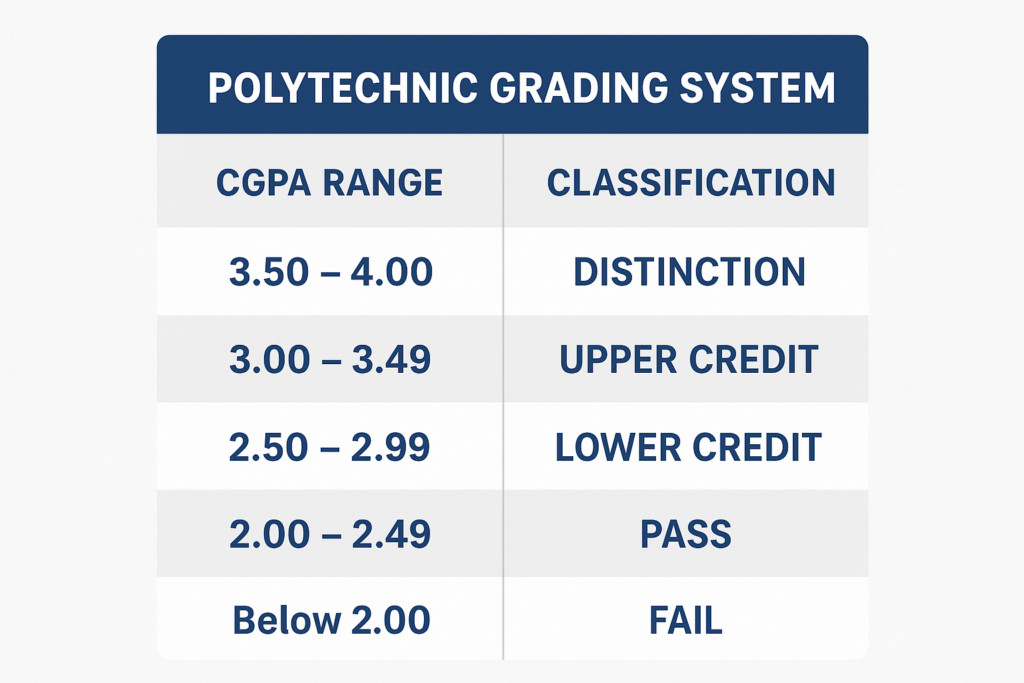
At the end of your program, your final CGPA determines your diploma classification. A CGPA between 3.50 and 4.00 earns a Distinction. A CGPA between 3.00 and 3.49 earns an Upper Credit. A CGPA between 2.50 and 2.99 earns a Lower Credit. A CGPA between 2.00 and 2.49 earns a Pass. Any CGPA below 2.00 is considered a Fail, and no diploma is awarded.
These classifications are uniform across Nigerian polytechnics and are recognized nationally.
ND and HND CGPA: Important Differences
For most students, ND and HND CGPAs are calculated separately. Your ND CGPA determines whether you qualify for Industrial Training and HND admission, while your HND CGPA determines your final diploma classification.
Some students wrongly believe that a strong HND result automatically cancels a poor ND result. In reality, institutions consider them independently, especially for employment and further education.
Common Mistakes That Destroy CGPA
Many students unknowingly damage their CGPA by making calculation errors or academic mistakes. One major mistake is ignoring failed courses. An F grade carries zero points and reduces your CGPA until the course is successfully retaken.
Another common mistake is misapplying the grading scale, especially assuming a 5.0 system like universities. Polytechnic grading is strictly on a 4.0 scale.
Some students also neglect practical assessments, which often carry significant weight. In polytechnics, practical performance can greatly influence final scores.
Difference Between Polytechnic and University CGPA
Universities in Nigeria use a 5.0 grading system, while polytechnics use a 4.0 system. This difference has caused long standing debates about equivalence. However, NBTE emphasizes that the polytechnic system is designed to reflect practical competence rather than purely theoretical performance.
A Distinction in a polytechnic is generally regarded as academically strong and professionally valuable, even though it is measured on a different scale.
Why Understanding CGPA Matters Beyond School
For students, CGPA affects graduation and career opportunities. For small business owners who employ interns or graduates, understanding CGPA helps in evaluating qualifications. For everyday Nigerians using smartphones to check results, scholarships, or job requirements, knowing how CGPA works prevents misinformation.
Many online calculators exist, but without understanding the logic behind CGPA calculation, it is easy to misinterpret results. Knowing the correct method puts you in control of your academic journey.
Understanding CGPA in Nigerian Polytechnics
The CGPA system in Nigerian polytechnics is standardized, fair, and transparent when properly understood. Once you know the grading scale, the role of credit units, and the correct calculation method, CGPA becomes straightforward rather than confusing.
Every polytechnic student should take time to calculate their CGPA personally each semester instead of waiting until final year. This awareness helps you make better academic decisions early and avoid unpleasant surprises at graduation.
Understanding your CGPA is not just about numbers. It is about planning your future with clarity and confidence.
Nice